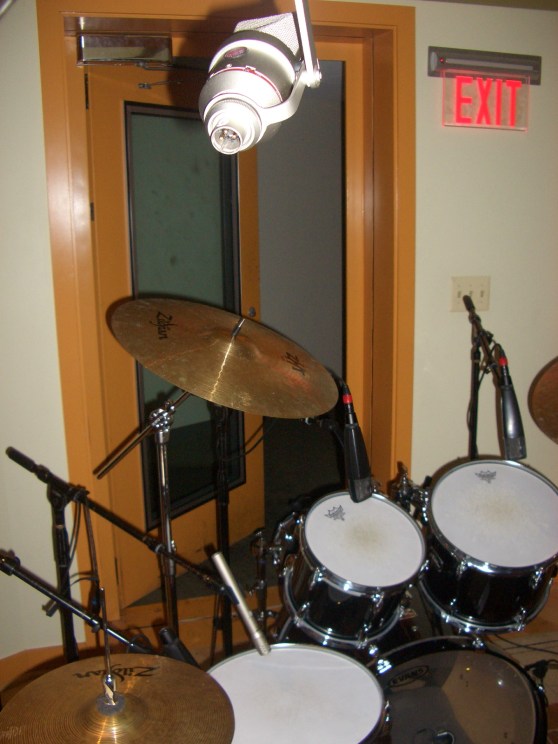
Second overhead setup: Neumann TLM 170 above the snare.
In my previous post, I reviewed Michael Stavrou’s “killer” approach to miking the drum kit — and left you in a bit of suspense (hopefully) regarding the element of the drum kit that felt some love from the second overhead mic. For that matter, I also left you hanging (at the edge of your seats, I know) when it came to revealing which microphone was selected for that second overhead. Well … TADA! Some of you will recognize the mic at the very top of the above photo as Neumann’s TLM 170, a large diaphragm side-address condenser mic with five switchable polar patterns, a low-cut filter, and a 10 dB pad (great for recording the kit’s high sound pressure levels). In AiW’s Studio A control room, my Advanced Studio Recording Techniques class listened at a comfortable dB level to the playback of the kit (played by our illustrious professor who shall for the time being remain nameless…sorry). Prior to that, we listened to the kit’s various instruments from inside the recording room. We wore ear plugs for protection, which still allowed us to hear and “feel” the kit…more on “feelings” in the next post.) After these listening exercises, we agreed that the snare drum had a special sound that would not only distinguish the kit (and drummer, perhaps) but also imbue a special flavor in the recording. Thus, the snare was miked with the TLM 170. In order to get the position and height just right, we moved around while our professor hit the snare only. Our objective was to find that sweet spot — “the flame” referred to in my previous post. Once we found it, we climbed on a stool and lifted our heads like ostriches and giraffes in order to identify the highest spot where that resonant sound remained in focus: 64 inches above the ground (see below).
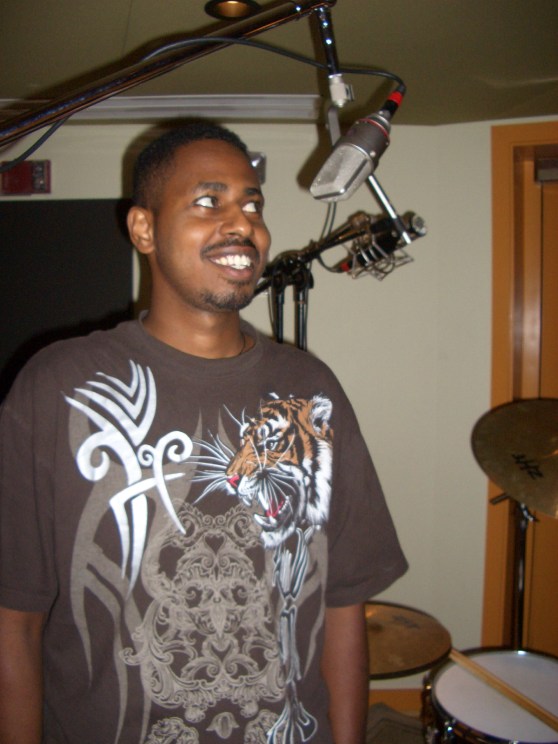
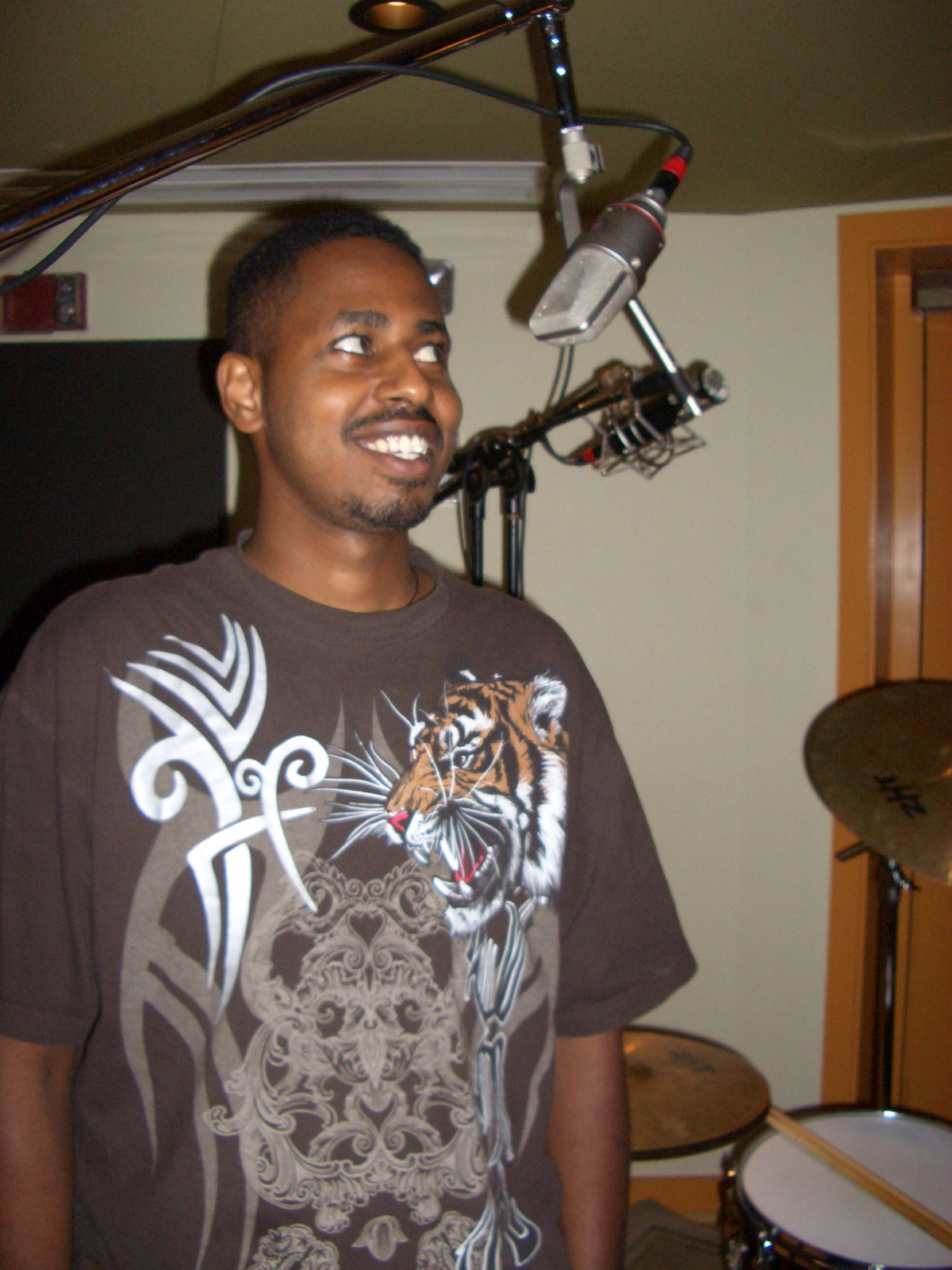
Audio engineer demonstrates the height of the Neumann TLM 170 (64 inches…sorry, buddy). This is the second overhead mic in our own “killer drum” setup.
Now that the overhead microphones are in place, it’s time to start recording … well, not quite. However, this leads me to address the final cliffhanger from Part I of this topic series: mixing. Based on this technique, the overheads will be the foundation of the mix. That’s right, I said it. The overheads — not the close mics, will be our starting point for mixing. Remember, we placed these mics in order to get the best sound possible out of our star players in the kit. By placing the mics in the flames of the unusual suspects, we can achieve a great recording without any close mics. (Once the close mics are inevitably introduced, their faders will start from the bottom and then be pushed upward until their sounds poke through in a meaningful way. In other words, the close mics will be mixed around the overhead mics.) Yep, I said it. One last thing for today: in order to minimize the loss of valuable frequencies, the phase of one of the overhead mics will be flipped during recording. I’ll end here for now.
“Tune in” next time for an explanation of Stavrou’s techniques for close-miking the kit as well as tips regarding phase!
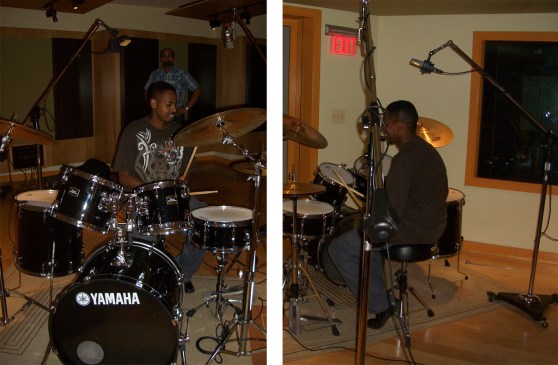
Overhead Drum Setup: Front and Rear View of the TLM 170 and AKG C414 over the snare and floor tom, respectively.


 Nana D. Kufuor