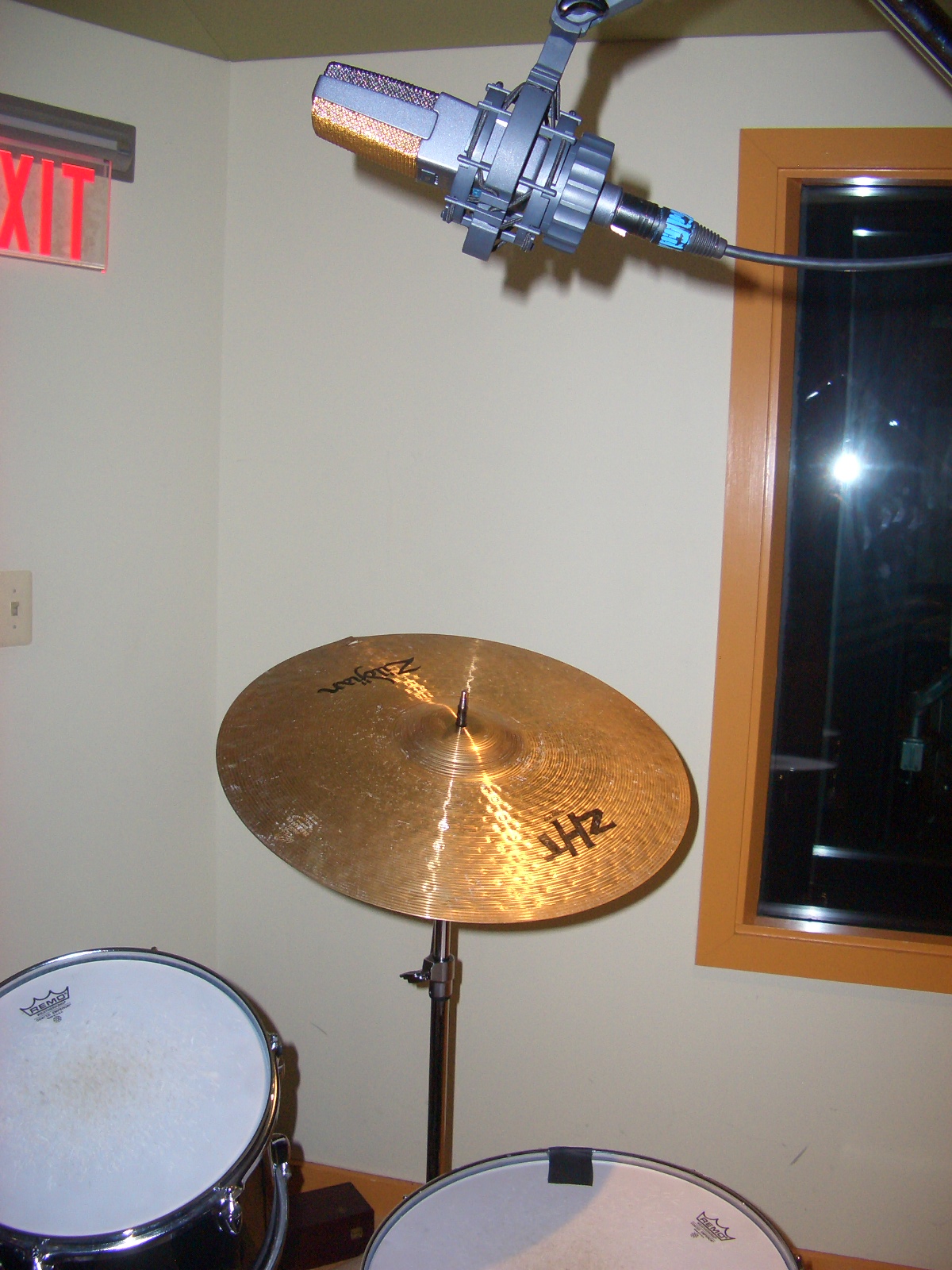
An overhead mic setup: AKG C414 above the floor tom
At the Art Institute of Washington, my Advanced Studio Recording Techniques class learned Michael Stavrou’s technique of choosing and placing microphones to get the best sound — an interesting sound — out of the drum kit. According to Stavrou, the key is to first place the floor tom in the recording space where the lower frequencies come into focus, then setup the kit around it… and then choose the microphone that best reproduces that low-end from the floor tom (and kick). It’s important to listen to the mic from the control room monitors (live drums tend to drown out the headphone mix) and to have the mic in an overhead position (at least an arm’s length away from the sound source, the tom in this case). Finally, place that chosen mic right where the low-end sound of the floor tom is locked in (Stavrou refers to that spot as “the flame”).
My class agreed that the AKG C414 (pictured above) won among four tested mics, which included the Neumann TLM 170, Aurycle A630 (large diaphragm side-address condenser with three switchable polar patterns), and AKG C451 B. (These mics were tested based on our results of Stavrou’s recommended microphone hardness test. For more on that, refer to Stavrou’s book, Mixing With Your Mind, or check the blog for updates on recording techniques.) Once the floor tom overhead is placed, the next overhead will be placed over another instrument on the kit that has a special sound or might add flavor to the song being recorded. Using the same technique for catching “the flame,” place the second overhead mic (again, by selecting hardness, testing and listening from the control room for that sweet spot).
“Tune in” next time to see which kit element and microphone we selected, as well as the first step toward mixing based on this recording technique!
 Nana D. Kufuor